
Last week, Oracle’s global layoffs hit the news hard.
Forbes described it as a 30,000-worker cut tied to surging AI spending. Reuters separately confirmed that Oracle has begun laying off thousands of employees as it ramps up AI infrastructure investment and absorbs restructuring costs of up to $2.1 billion, mostly severance. Whether the final number lands in the thousands or closer to the top-end estimates, the signal is the same: AI is no longer just changing work. It is changing who gets to stay in it. (Forbes)
That should matter to everyone.
But it should especially matter to neurodivergent workers.
Because information technology has long been one of the few sectors where many neurodivergent people could build stable careers. Systems thinking, pattern recognition, deep focus, process work, technical troubleshooting, and structured environments have often made tech a relative safe haven. Not perfect. But viable.
And now those same structured, repeatable, cognitively “clean” layers of work are some of the first being redesigned, compressed, or removed.
This is not just a tech story
Oracle is one company. But it is also a signal.
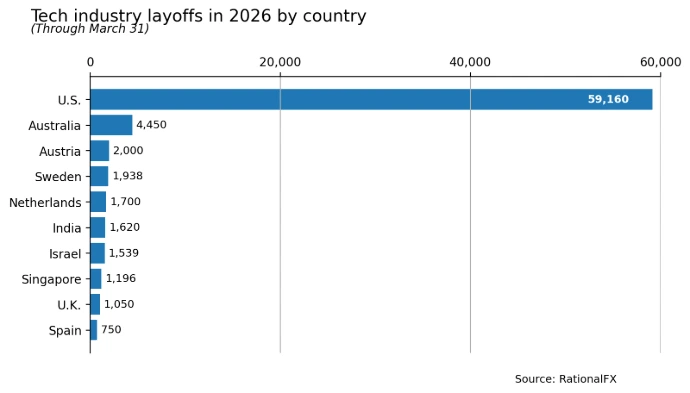
Reuters reports that more than 70 tech companies have cut over 40,000 jobs in 2026 as firms shift resources toward AI. The IMF says around 60% of jobs in advanced economies are exposed to AI in some way. And the World Economic Forum says technological change is reshaping both task demand and skills demand across industries. (Reuters)
That does not mean all those jobs disappear.
But it does mean work is being broken apart and redesigned faster than most people are ready for.
And when that happens, neurodivergent workers often feel the change first.
Not because they are less capable.
Because they are more exposed to instability in role design, sensory load, ambiguity, pace, and the loss of structured pathways.
Thousands unemployed because of AI
It is only March 31, and already thousands of skilled tech jobs have been lost to AI improvements. How much worse will this look by year’s end? It is the beginning of a wider workforce reckoning and we are the creators of our own doom?
What is really happening here?
The easiest story is: AI is replacing people.
The more accurate story is: AI is replacing certain kinds of work
Many argue that we need to get trained in AI to stay relevant. But in a world where AI is already writing the next iteration of itself, is that really a strong argument not to see this as the crisis is really is?
That matters for neurodivergent workers in two ways.
First, for people already in jobs, AI often increases the pace around them.
More speed.
More switching.
More pressure to interpret, respond, and recalculate in real time.
Tasks that once had rhythm now have acceleration. Roles that once had defined boundaries become more fluid, more abstract, and more exposed to constant change. For neurodivergent employees — especially those who rely on routine, clarity, deep focus, or predictable workflow — that shift can quietly turn a manageable job into an unsustainable one.
Second, for neurodivergent job seekers, AI is stripping out many of the structured entry points that once allowed people to get in, learn, stabilise, and prove their value.
That is the bigger risk.
Not just job loss.
It is PATHWAY loss.
IT was never just a sector. It was a pathway.
For many neurodivergent people, technology work offered something rare:
A way in.
It was one of the few places where being highly focused, detail-oriented, systems-minded, or less socially performative could still be translated into economic value.
That matters more than people realise.
Because when AI removes or compresses the junior, repeatable, process-heavy parts of tech work, it does not just save cost.
It removes some of the very roles that helped neurodivergent people enter the workforce in the first place.
And once those roles disappear, the labour market does not fail loudly.
It just becomes harder to enter.
Are we sleepwalking into another Great Depression?
Not in the historical sense.
The Great Depression was a collapse.
What looks more plausible now is something quieter and, in some ways, harder to see.
A labour market where there is still work, but less access.
A labour market where there are still jobs, but fewer safe on-ramps.
A labour market where people who once could have found a foothold are instead expected to arrive fully formed, socially polished, fast, adaptable, and immediately productive.
That is not a crash.
It is a narrowing.
And for neurodivergent workers, narrowing can be just as destructive.
What might the next year look like?
Over the next 12 months, the most visible change is likely to be more restructuring and slower entry-level hiring.
AI will continue to be sold as a productivity tool, and in many cases it will be one. But alongside that, organisations will hire fewer people into junior support, admin-heavy, or process-based roles. Existing staff will be asked to absorb more complexity, more speed, and more ambiguity. Oracle is one visible example of that shift. (Reuters)
For neurodivergent incumbents, that means more pressure to adapt to machine-paced environments.
For neurodivergent job seekers, it means fewer first chances.
What might three years look like?
In three years, the labour market may become more polarised.
There will still be work. But more of it will cluster at the high-skill strategic end or the in-person human service end. The middle layer — especially structured junior knowledge work — may thin out dramatically.
That is not just a labour market shift.
It is an access shift.
Because a lot of people do not enter work through high-level strategic roles. They enter through roles that let them learn by doing, make mistakes safely, and build confidence over time.
Take away that middle and the issue is no longer whether people are capable.
It is whether the system still gives them a way in.
What might five years look like?
In five years, the organisations that do best may not be the ones that replaced the most people.
They may be the ones that redesigned work most intelligently.
Because AI will not just reward efficiency.
It will reward role design.
The companies that keep neurodivergent talent will be the ones that ask better questions:
What parts of this role genuinely need human judgement?
What structured learning still needs to happen somewhere?
What pathways are we removing — and what is replacing them?
How do we keep pace from becoming punishment?
If they do not ask those questions, the future of work will not become more inclusive.
It will become narrower, faster, and more excluding by default.
The real risk for neurodivergent workers
The real risk is not that AI directly “targets” neurodivergent people.
There is no evidence Oracle’s layoffs singled out neurodivergent workers as a group.
The real risk is more structural than that.
AI is removing or transforming the kinds of roles and environments that many neurodivergent workers historically used to:
enter employment
build confidence
develop capability
stabilise income
and stay
That is the issue.
If those structures disappear and nothing is deliberately designed to replace them, then the people most dependent on structured pathways will be hit first.
Not because they cannot work.
Because the work that let them in no longer exists.
One practical question for leaders
Ask this now, before the market answers it for you:
If AI removes the junior and repeatable parts of work, what replaces the learning, predictability, and progression those roles used to provide for neurodivergent workers?
If the answer is unclear, then your AI strategy may be improving efficiency.
But it is not building a future workforce.
The bottom line
Oracle’s layoffs are not just a company story.
They are a warning shot.
Forbes may have framed it as a 30,000-worker shock layoff, while Reuters has so far confirmed thousands of cuts amid Oracle’s AI-driven restructuring. The exact number matters less than the direction of travel: companies are spending more on AI and asking fewer people to do the work. (Forbes)
For neurodivergent workers, the danger is not simply job loss.
It is the disappearance of the structures that once made work possible.
And if we do not redesign access now, the next employment crisis will not arrive as one dramatic collapse.
It will arrive as a quieter truth:
In chasing maximum efficiency, the IT sector may be engineering its own employment crisis — allowing AI to strip away the pathways that once let skilled talent get in, grow, and stay.