
Originally posted 16 March 2026.
The word “neurotypical” gets used a lot now. In conversations about autism. ADHD. Learning differences. Mental health. Workplaces.
But if you stop most people in the street and ask what it actually means, the answers are usually vague.
Some people think it means “normal.”
Others think it means “people without any neurological differences.”
In reality, neither of those definitions is accurate.
Understanding what neurotypical really means can help us move past some of the confusion in the neurodiversity conversation.
Neurotypical Does Not Mean “Perfectly Average”
Many people assume that being neurotypical means having a perfectly “average” brain. In reality, that’s not how human cognition works.
In psychology and neuroscience, human traits tend to follow statistical distributions. Things like attention regulation, sensory sensitivity, working memory, emotional regulation, social processing, pattern recognition and impulse control vary across the population.
Some people are higher on these scales.
Some people are lower.
Most people fall somewhere in the middle range.
But when many traits are considered together, almost nobody sits exactly in the middle on all of them.
Every person develops their own cognitive profile — strengths in some areas and challenges in others.
So, when professionals talk about someone being neurotypical or neurodivergent, they are not suggesting that one brain is perfectly shaped and another is somehow warped.
They are usually describing something much simpler:
How closely a person’s cognitive profile fits the environments and expectations that society’s systems are designed around.
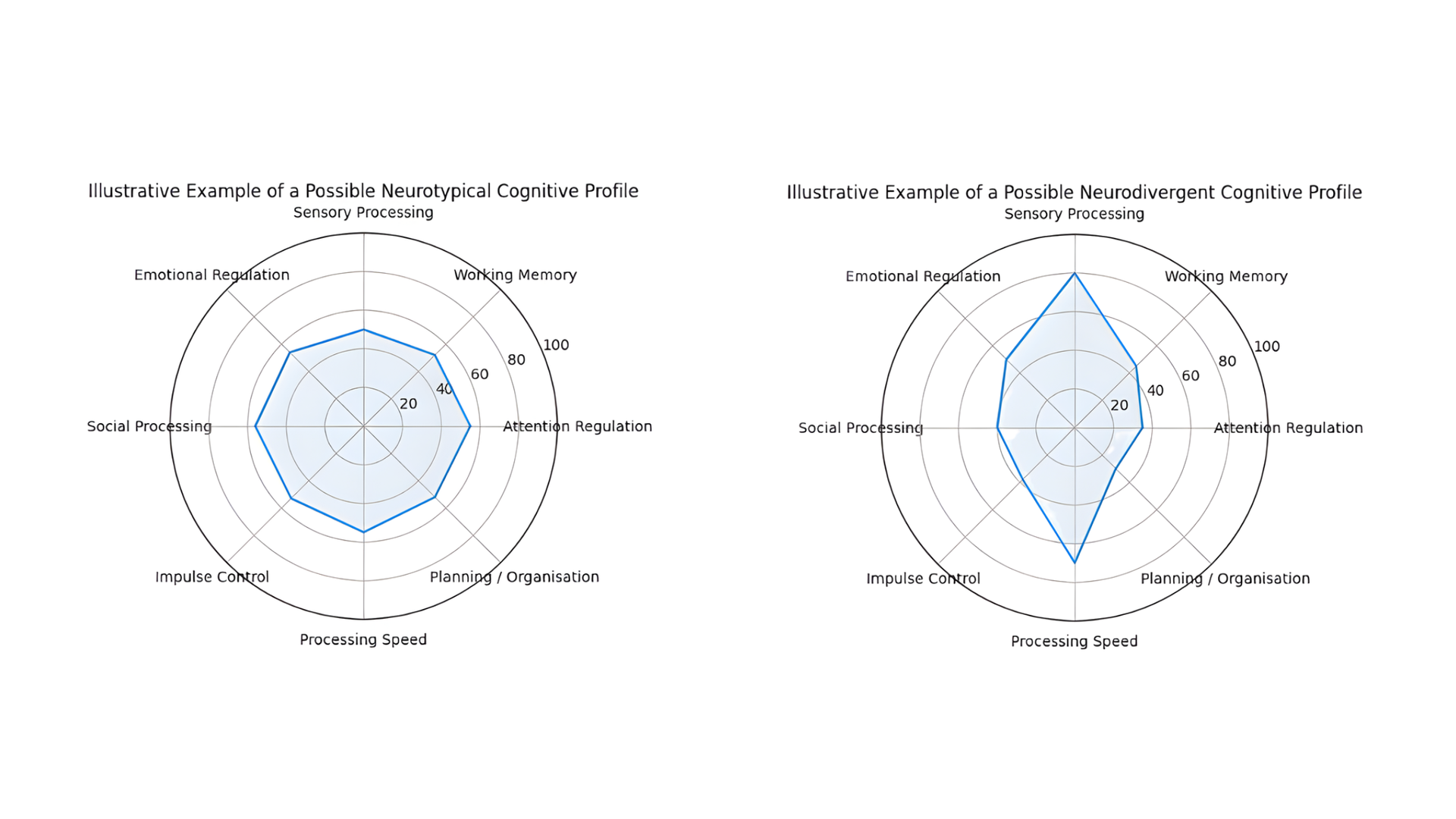
Neurotypical Usually Means “Within Expected Ranges”
That includes things like:
- being able to focus in typical classroom or workplace environments
- managing daily tasks without major external support
- processing social cues in common ways
- regulating emotions without significant intervention
In other words, the person can operate in mainstream environments without major adjustments.
This doesn’t mean they never struggle — everyone struggles sometimes.
It simply means their brain tends to fit the structures society already uses.
Neurotypical Is a Statistical Idea — NOT a Moral One
One of the biggest misunderstandings is that “typical” implies better, correct, or superior.
In science, it doesn’t mean that at all. It simply means more common.
Just like height — most men fall between certain height ranges.
Some are much taller.
Some are much shorter.
Neither is morally better — it’s simply statistical variation.
Brains work in a similar way.
The Real Issue: Mismatch
Neurodiversity often comes into focus when a person’s brain or behaviour doesn’t align with the environments they are expected to navigate.
This is where the Implementation Gap appears — the space between knowing what to do and actually being able to follow through.
For example:
- a student with high sensory sensitivity placed in a noisy classroom
- a highly creative person working in a rigid, repetitive role
- an employee working in an environment that relies heavily on complex social politics
The challenge isn’t necessarily the brain itself. Often the challenge is the environment the brain is placed into.
This is why support strategies, workplace adjustments, coaching, different learning approaches, or finding employment that better fits a person’s strengths can make such a difference.
When the Environment Doesn’t Fit
Anxiety is often a large part of this conversation.
When a person’s brain doesn’t align well with the environment they often believe there is something wrong with them.
The result is often ongoing stress. Over time, that stress can settle into a constant state we recognise as Anxiety.
This raises an interesting question.
Modern systems have become increasingly structured. Roles are tightly defined. Processes are standardised. Job descriptions, school expectations and performance measurements are often very specific.
Today, most people are expected to fit the system.
But it wasn’t always like this.
In earlier generations, the pace of life and work was slower. Workplaces and communities made quiet adjustments. Tasks shifted. Roles evolved. People had more space to lean into what they were naturally good at.
Today, the world is faster, more structured.
And people are expected to twist themselves into pretzels to fit the environment and expectations of the organisation.
Rather than the person being the problem, is anxiety sometimes a signal that the environment is not a good fit for the person?
For many people, the real challenge may not be capability.
It may be their environment.
Everyone Is Different
One way to think about variation in human cognition is to imagine a forest.
Many trees may belong to the same species, but no two grow in exactly the same way.
Some reach higher.
Some bend toward the light.
Some spread wide branches.
The soil, wind and sunlight all influence how each tree develops.
Some plants thrive in conditions where others struggle.
Human brains are much the same.
There may be common patterns, but variation is everywhere.
Diversity isn’t unusual — it’s the natural condition.
Some differences are small.
Some are more pronounced.
Some create challenges that might thrive better in a different environment.
But diversity itself is part of being human.
The Bottom Line
“Neurotypical” doesn’t mean a perfect brain.
It doesn’t mean someone has no struggles.
And it certainly doesn’t mean everyone else is broken.
In practice, it simply means a brain that fits reasonably well within the environments our schools, workplaces and systems were designed around.
But the reality is that human cognition is naturally diverse.
Some people sit closer to the statistical middle.
Some people sit further from it.
The real work is not forcing everyone into the same mould.
The real work is understanding how different brains interact with the real world — and building environments and structures that encourage them to thrive.
At Ability Pathways, this is exactly where we focus.
Diagnosis is often just the starting point.
The real question comes next:
How do we bridge the gap between understanding a diagnosis and building a life that truly works for that person’s brain?